
The Gandak river's water level in Bihar is showing a receding trend, bringing relief to low-lying areas after flash floods in Nepal caused a surge. Despite a marginal rise due to late-night rainfall in Nepal, authorities are monitoring the situation closely, with no adverse impact on embankments reported.

Parts of Bihar are facing a potential deluge as major rivers like the Ganga, Gandak, Kosi, and Burhi Gandak show rising water levels. This surge is attributed to devastating flash floods and continuous rainfall in neighbouring Nepal, prompting authorities to open barrage gates and place disaster response teams on standby.

Bihar and Uttar Pradesh are on high alert following devastating flash floods in Nepal's Gandak river system, prompting emergency measures including evacuations and continuous monitoring by central and state authorities.

The administration has sounded a high alert in Maharajganj and Kushinagar districts of Uttar Pradesh, while stepping up the monitoring of the Gandak and other water bodies downstream of rivers in Nepal, following devastating flash floods in the neighbouring country that have killed more than 350 people and left thousands missing.

The rising water level in the Narayani-Gandak river following heavy rainfall in Nepal has increased the flood threat in villages along the river in Maharajganj district, officials said on Sunday.

Three unidentified bodies, believed to have drifted from Nepal due to devastating floods, were recovered from the Gandak river in Uttar Pradesh's Kushinagar district. This incident follows a similar recovery of four bodies in neighbouring Maharajganj, highlighting the cross-border impact of the Nepal floods which began on August 26. Authorities are coordinating with Nepal to identify the deceased and are monitoring the river situation.


Nepal's devastating flash floods have created a worrisome flood situation in Bihar.

Villages along the Uttar Pradesh-Bihar border are on high alert following devastating flash floods in Nepal, with authorities monitoring the Gandak River for potential downstream surges and the NDRF deploying 20 teams for preparedness.

Heavy rainfall and swollen rivers have led to severe flooding in 15 districts of Bihar, affecting over 49 lakh people. Major rivers like the Ganga and Kosi are flowing above danger levels, prompting the deployment of disaster response teams and the establishment of relief camps and community kitchens for those displaced.

The National Disaster Response Force (NDRF) is closely monitoring the India-Nepal border regions in Bihar and Uttar Pradesh for any adverse impact from the devastating flash floods in Nepal. While no significant impact has been reported yet, 20 NDRF teams are deployed in the Indian states for potential relief operations. India has also sent humanitarian aid to Nepal and has additional NDRF teams on standby for deployment if requested.

Floods have forced hundreds of government schools across Bihar to shut, disrupting studies for thousands of students.

'This is no longer a single-hazard problem; it is a cascading, multi-hazard problem. A landslide never occurs in isolation. This entire chain is the cascading effect of what looks, at first, like a single disaster.'

Many low-lying areas in West Bengal's sub-Himalayan region were reeling from a flood-like situation while major rivers in Bihar were flowing above the danger level at several places as unabated heavy rain lashed the country's eastern parts on Sunday.

Central Water Commission sources said the situation continued to be grim following incessant rains in the catchment areas of these rivers.

More than 45 lakh people in 30 out of the total 38 districts of the state have been affected by the calamity in two phases since last month, according to the Disaster Management Department.
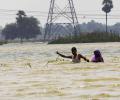
Swirling waters inundated 12 districts of Buxar, Bhojpur, Patna, Vaishali, Saran, Begusarai, Samastipur, Lakhisarai, Khagaria, Munger, Bhagalpur and Katihar.

Flood victims have been fighting for survival and living in temporary shelters nearby railway tracks with lack of food items. They are yet to get any help from the government, reports M I Khan.

In Assam, nearly 27.80 lakh people across 26 districts have been affected by the deluge. The deaths were reported from the Barpeta, Kokrajhar and Morigaon districts. The death toll due to floods and landslides this year has risen to 122.
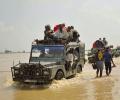
With the rise in level of the Ganga, Bihar Chief Minister Nitish Kumar has expressed apprehension of further rise in water level by Monday in view of release of water from Bansagar dam as flood-like situation prevailed in the state.

People lost their lives in the affected districts due to incidents of drowning, electrocution, house collapse and falling of trees, a disaster management department release said.

Thousands of people in Darbhanga, West Champaran and Nalanda districts in Bihar have been affected by floods after rivers flowing through these districts breached their embankments. Floods occurred in Darbhanga and West Champaran districts after breaches developed in the embankments of Kamla Balan and Gandak rivers respectively, while in Nalanda it was due to the overflowing of Panchane river.

In Uttar Pradesh, two persons were killed since Tuesday in the floods which have affected around 8.7 lakh people in 987 villages of 28 districts in the state.
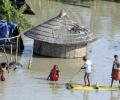
With reports of eight fresh deaths on Thursday, the total toll in Bihar flood increased to 135, with Bhojpur district accounting for 12 deaths in the second round of floods due to the swollen Ganga.

Floods have ravaged 12 of the 37 districts in the state -- the worst-affected being Patna, Vaishali, Bhojpur, Khagaria and Samastipur districts.

Four persons have died in Bihar since Monday in rain-related incidents due to the 'peripheral effect' of Cyclone Phailin, taking the death toll in the state to 14.
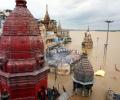
The water level of major rivers, including the Ganga and the Yamuna, in Uttar Pradesh has crossed the danger mark at several places.

A high alert has been issued in the state after the landslide in Nepal. Precautionary measures have been completed," said Bihar's CM.

'Did the government learn any lesson from the disasters of 2008, 1987, 1975?' 'Certainly not!' 'They are making people believe that the 2017 flood was unexpected, so no preventive effort towards reducing the loss of human lives was to be expected from the government,' says Mohammad Sajjad.

'Consider this image of today's youth in Bihar -- armed with a bike, a smartphone and possibly some illegal arms too, imbibing incessant stream of images from the Internet and television.' 'Some of them would turn into gau bhakts, some would listen with interest the exploits of Salafism, dig deep into the Internet to come out with images which cry vociferously that their respective religions are in danger.'
